

Industrial Bucket Elevators: Key Design Features
Oct 05, 2026
In modern chemical and grain processing plants, efficient material handling is essential to keeping production running smoothly. Vertical conveying is a particularly important part of the process, yet it often comes with challenges such as material buildup, component wear, dust leakage and high energy consumption.
Traditional bucket elevators are often designed as standalone pieces of equipment, which can limit overall performance. A more integrated approach considers the entire conveying process, from feeding and lifting to discharge, maintenance and long-term operation.
This article explores several key design features that help address these challenges and ensure reliable, efficient vertical conveying.
Improving Conveying Efficiency
A bucket elevator's performance depends largely on how effectively it handles material throughout the conveying cycle.
The combination of a multi-layer, three-protection rubber belt and high-strength CC-type deep buckets provides reliable material handling. With densely arranged buckets and an adjustable inlet guide plate, the system supports controlled, direct feeding into the buckets.
This feeding arrangement helps reduce material rollback and unnecessary digging, improving conveying efficiency by at least 15% compared with conventional designs. It also helps minimize component wear and energy losses.
The drive system combines an explosion-proof motor with a gearbox connected to the foundation through a torque arm. This arrangement provides stable power transmission and reliable operation, including in applications with lifting heights of up to 60 metres.
Simplifying Installation and Maintenance
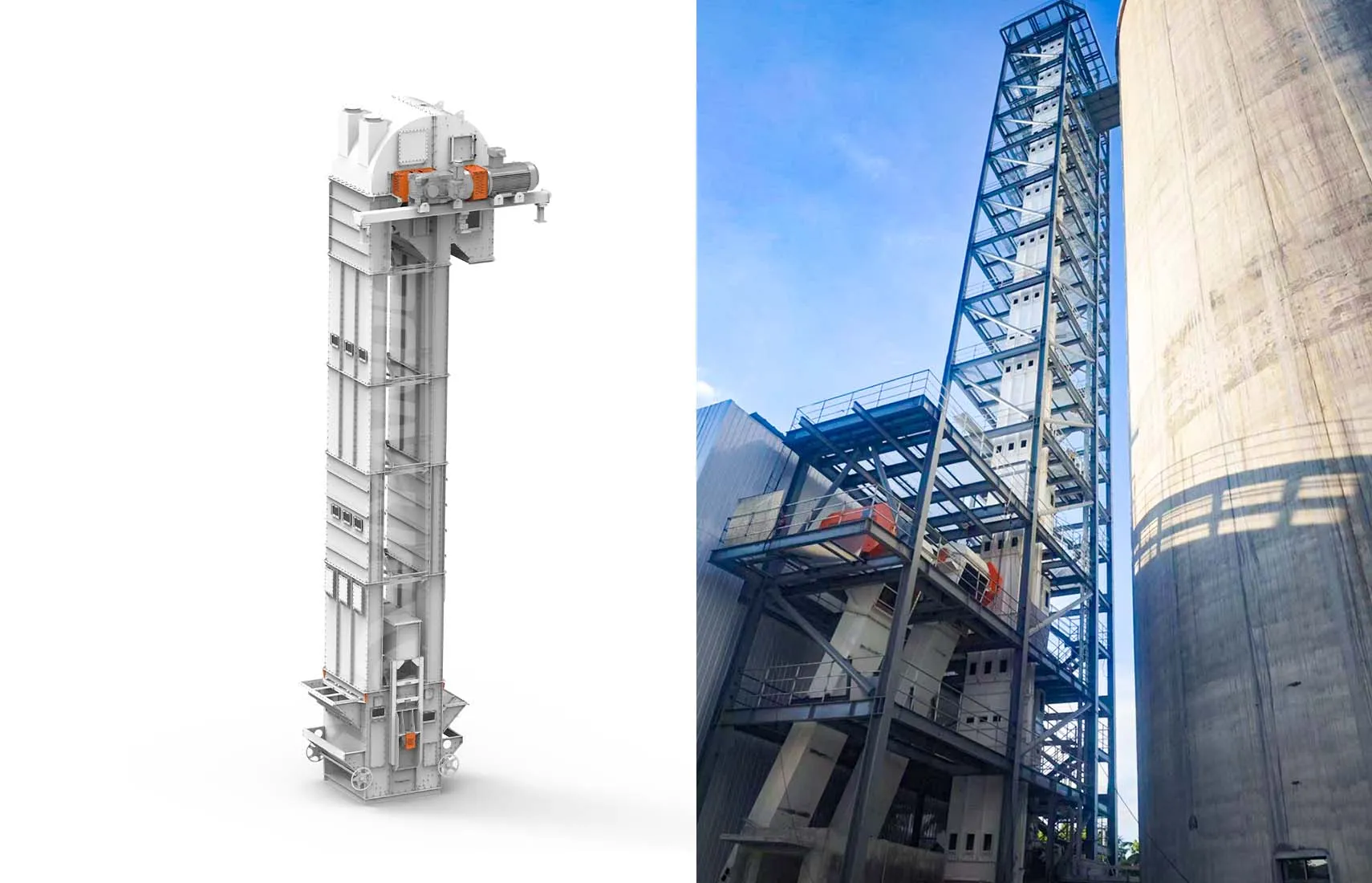
A bucket elevator typically consists of four main sections: the boot, casing, head and drive system. Each section plays a role in ensuring reliable operation and convenient maintenance.
At the boot, a gravity take-up system automatically compensates for belt elongation and maintains proper belt tension, helping prevent slippage.
The casing uses bolted flange connections instead of conventional welded construction. This helps minimize structural deformation, maintain vertical alignment and simplify dismantling when maintenance is required. An optional explosion-relief casing section is also available for applications involving combustible dust, subject to the project's safety requirements.
At the head, a quick-opening cover provides easier access for inspection and maintenance. The modular design also supports manufacturing accuracy and more efficient on-site installation.
For demanding environments, the casing can be finished with a special powder coating to improve resistance to moisture and salt spray.
Controlling Dust and Improving Safety
Dust control is an important consideration in grain processing, food production and chemical plants, where airborne particles can affect workplace conditions, product quality and operational safety.
A negative-pressure design helps keep dust inside the elevator casing during operation. An optional aspiration system can further improve dust collection and reduce the escape of airborne material.
For applications involving combustible or explosive dust, an optional explosion-relief section can be incorporated into the design. The appropriate protection measures should be determined according to the material properties, site conditions and applicable safety regulations.
Reducing Energy Consumption
Efficient feeding and discharge can reduce unnecessary mechanical work and improve the overall energy performance of a bucket elevator.
By minimizing material rollback and reducing inefficient handling during loading and unloading, the TDTG Series can achieve energy consumption more than 20% lower than conventional models. For continuously operating production lines, this can translate into meaningful long-term electricity savings.
Choosing the Right Bucket Elevator
Equipment selection should go beyond conveying capacity and lifting height. Material characteristics, including particle size, bulk density, moisture content and flowability, can all influence equipment configuration and performance.
Other important factors include available installation space, process requirements, dust-control needs and the operating environment. Proper consideration of these factors during the design stage helps ensure that the equipment is suited to the actual production conditions.
Long-term performance also depends on installation quality, commissioning, maintenance support and spare parts availability. A well-designed equipment solution should account for these requirements throughout its service life.
Myande TDTG Series Bucket Elevators
The Myande TDTG Series Bucket Elevator brings together optimized feeding and discharge, modular construction, dust-control features and energy-efficient operation in one integrated design.
Backed by Myande's engineering and equipment manufacturing capabilities, the series can be configured according to material characteristics, lifting height, plant layout and specific process requirements. Myande also provides support covering equipment design, manufacturing, installation, commissioning and after-sales service.
Designed for grain and oil processing, food production and chemical applications, the TDTG Series offers a reliable solution for vertical bulk material conveying.

Recent Posts

October 26, 2016
The Most Successful Engineering Contractor

Sep 29, 2026
How to Choose the Right Starch Processing Equipment?


Contact Us
Product Information
Quantity
Unit
Piece
Support order samples, customization, wholesale direct, and complete payment. If the product you look for does not have corresponding customized content, pls fill out the form below to contact us, and we will reply ASAP.