

Corn Starch Production Line: Process, Equipment and Capacity?
Sep 24, 2026
A corn starch production line can appear to be a simple collection of machines, but that view creates costly procurement mistakes. I often see project discussions focus on a TPD number before confirming raw material, products, utilities, and by-product plans. I recommend evaluating the complete process system first, then selecting equipment and capacity around realistic operating conditions.
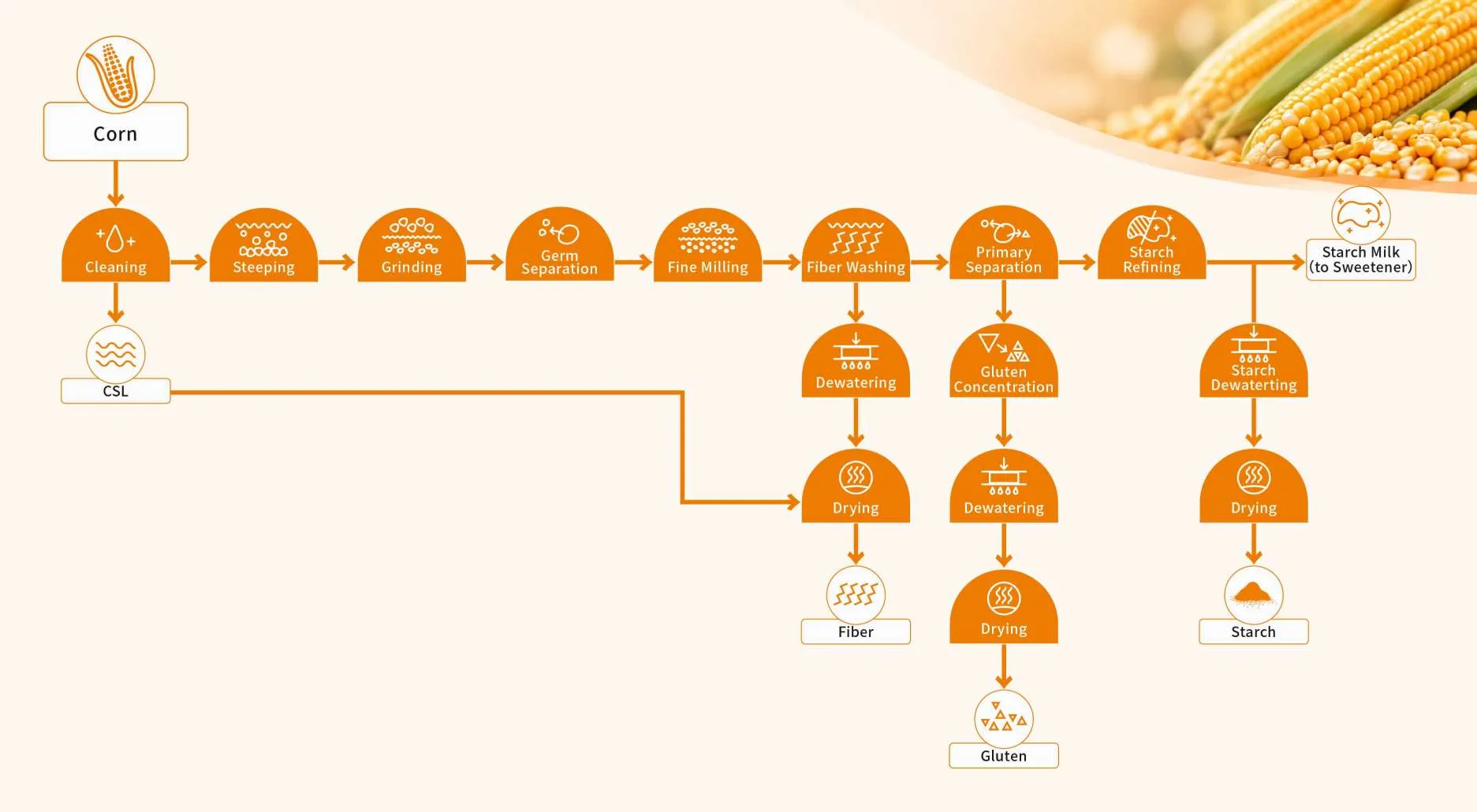
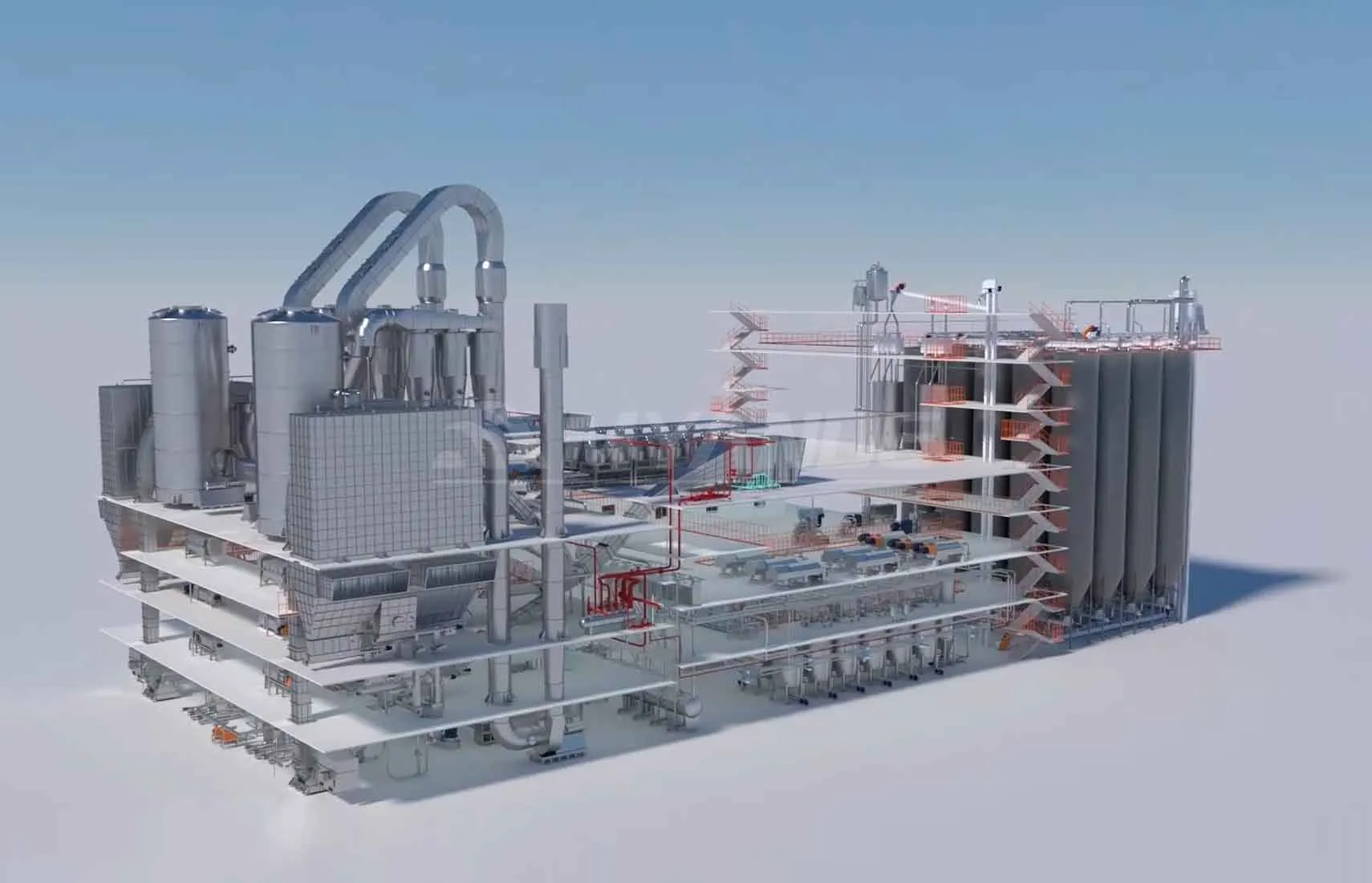
A corn starch production line should be designed as an integrated system rather than purchased as a machine list. The process normally includes corn receiving, cleaning, steeping, milling, germ and fiber separation, starch-protein separation, washing, dewatering, drying, and by-product handling. Realistic capacity depends on corn quality, operating hours, maintenance, utilities, product specifications, and downstream bottlenecks—not only the supplier’s nominal TPD rating.
When I discuss a new project with an agricultural group or food ingredient producer, I begin with the business objective. A plant producing only native starch has different priorities from a plant that also sells germ, gluten, fiber, glucose, or fermentation feedstock. The following sections explain how I connect process design, equipment selection, and capacity evaluation.
How does a corn starch production line work?
A poorly connected process can reduce yield, quality, and operating stability even when individual machines meet their specifications. I therefore evaluate each stage as part of a continuous system. The key question is not simply what each machine does, but how reliably the complete line transfers material from corn to saleable products.
A typical corn starch production line receives and cleans corn, softens it through steeping, mills it, separates germ, fiber, and protein, washes the starch, removes water, dries the product, and processes by-products. Each section affects the next one. For example, inconsistent steeping can make milling and separation less effective, while insufficient drying capacity can limit final starch output.
Main process stages
1. Receiving and cleaning
Corn handling systems remove stones, metal, dust, and other impurities. Storage and conveying equipment should maintain a consistent feed rate. Poor cleaning can damage downstream equipment and introduce quality risks.
2. Steeping and water management
Steeping softens the corn and prepares it for effective milling. Tanks, circulation systems, temperature control, and process-water management must match the raw material and intended production rate. Steeping conditions require engineering confirmation rather than a universal setting.
3. Milling and germ separation
Milling releases the germ and separates the kernel components. Germ recovery is commercially important because it can support oil production or other value-added uses. Excessive milling or unsuitable loading may increase fines and complicate later separation.
4. Fiber and protein separation
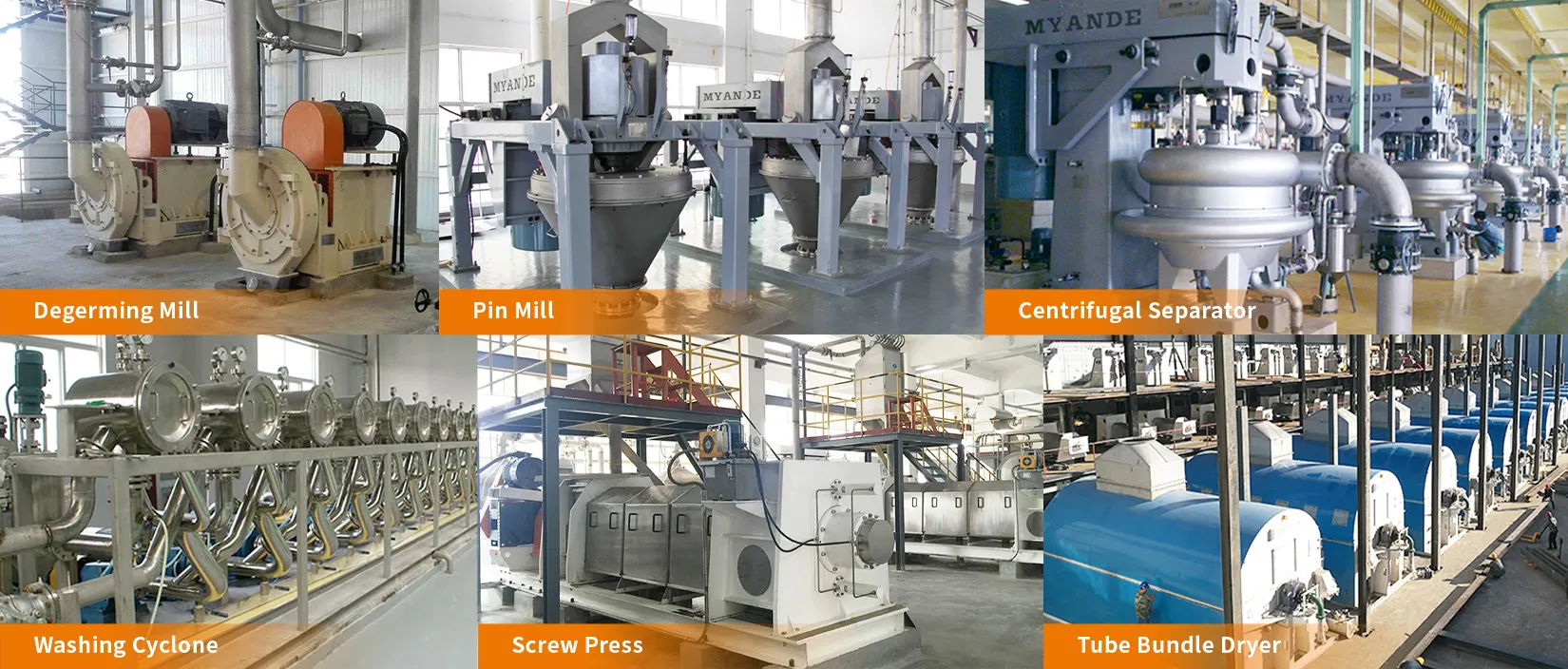
Hydrocyclones, screens, centrifuges, separators, and related equipment may be used according to the process route. These systems influence starch purity, protein recovery, water use, and by-product quality.
5. Starch washing and refining
Washing removes soluble and insoluble impurities. The washing section must achieve the target purity without creating unnecessary water consumption or unstable circulation. I recommend reviewing impurity load, product specifications, and cleaning requirements together.
6. Dewatering and drying
Vacuum filters, centrifuges, flash dryers, or other systems reduce moisture and produce dry native starch. Drying is often a major utility consumer and can become a capacity bottleneck if it is undersized.
7. By-product handling
Germ, fiber, protein-rich streams, steepwater, and process water should be considered during the initial design. A project that ignores these streams may lose revenue and create additional environmental costs.
A complete-line supplier should explain material flow, control points, cleaning procedures, maintenance access, and expected operating interfaces. I would also request a process flow diagram and mass-balance basis before comparing quotations.
What does capacity mean in a corn starch production line?
Capacity is often misunderstood because suppliers and buyers may use different definitions. I have found that a clear capacity basis prevents many commercial disputes. Investors should ask whether the quoted figure refers to corn input, wet starch, dry starch, or a theoretical design maximum.
Capacity in a corn starch production line may refer to corn input per day, wet starch output, or dry native starch output. These figures are not interchangeable. Stable production also depends on raw-material conditions, annual operating days, planned maintenance, equipment loading, drying capacity, utilities, and the performance of the entire process—not one machine.
Capacity definitions to clarify
| Capacity term | What it describes | What buyers should confirm |
| Corn input capacity | The amount of corn processed over a stated period | Moisture, impurities, operating hours, and feed consistency |
| Wet starch output | Starch slurry or wet cake before final drying | Moisture level and product measurement point |
| Dry starch output | Finished starch after dewatering and drying | Final moisture, purity, quality standard, and packaging basis |
| Nominal TPD | A design or rated figure | Whether it represents continuous, average, or peak operation |
| Stable capacity | Output achieved under defined operating conditions | Raw material, utilities, maintenance, and performance criteria |
A supplier should state the operating assumptions behind every capacity figure. Those assumptions may include corn moisture, kernel quality, daily operating hours, cleaning schedules, utility availability, and target starch specifications.
Why nominal TPD is not guaranteed production
A line may be mechanically capable of a stated throughput, but the plant may not sustain that rate throughout the year. Maintenance shutdowns, seasonal corn variation, unstable steam supply, water limitations, operator experience, and downstream drying can reduce actual production.
I recommend asking for three separate figures:
🔸Design capacity
🔸Expected stable operating capacity
🔸Capacity under less favorable raw-material conditions
The project team should also identify the likely bottleneck. In some plants, milling or separation limits throughput. In others, drying, evaporation, wastewater treatment, storage, or packaging becomes the constraint. A complete engineering review should connect capacity with mass balance, utility balance, automation, and maintenance planning.
How should buyers select equipment for a corn starch production line?
A machine list rarely reveals whether a proposed plant fits the commercial strategy. I have participated in project discussions where the equipment specification changed after the customer clarified that by-products or downstream glucose were important. Equipment selection should begin with the target product portfolio and raw-material profile.
Buyers should select corn starch production line equipment according to the intended product mix, raw-material characteristics, capacity basis, quality targets, utility conditions, and by-product recovery plan. A dry native starch line, a full wet-milling complex, and a starch-to-glucose project require different process sections, controls, storage systems, and performance evaluations.
Define the product strategy first
A project may target one or more of the following:
🔸Native corn starch
🔸Corn germ for oil or feed applications
🔸Gluten or protein-rich products
🔸Corn fiber
🔸Glucose or glucose syrup
🔸Modified starch
🔸Fermentation-grade glucose
If the customer plans to expand into glucose, sorbitol, organic acids, or amino acids, the initial plant layout should reserve space and utility capacity where practical. The downstream route may require liquefaction, saccharification, filtration, decolorization, ion exchange, evaporation, crystallization, or fermentation support.
Evaluate equipment as a system
I recommend comparing suppliers across these categories:
1. Process suitability: Does the proposed route match the corn type and product specifications?
2. Material handling: Can receiving, storage, and conveying maintain a stable feed?
3. Separation performance: How will the line manage germ, fiber, protein, and starch streams?
4. Automation: Can operators monitor flow, density, temperature, pressure, moisture, and quality indicators?
5. Maintenance: Are wear parts, inspection points, cleaning systems, and spare parts accessible?
6. Integration: Does the supplier cover utilities, wastewater interfaces, packaging, and by-product handling?
7. Project execution: Can the supplier provide engineering, manufacturing, installation support, commissioning, and training?
I would avoid selecting equipment solely by model number or lowest purchase price. A lower CAPEX option may create higher water, energy, labor, maintenance, or product-loss costs. Conversely, a more advanced system is not automatically better if the local team cannot operate or maintain it effectively.
Which raw-material details should be confirmed before requesting a quotation?
Raw material is one of the most important design variables in a corn starch project. A quotation based only on the phrase “corn starch plant” is unlikely to reflect the real operating conditions. I recommend supplying representative information before suppliers finalize process guarantees or equipment sizing.
Before comparing corn starch production line suppliers, buyers should provide corn variety, moisture, impurity level, seasonal variation, supply consistency, kernel characteristics, storage conditions, and target products. These inputs can affect steeping, milling, separation, starch quality, yield, water use, capacity, and the design of cleaning and by-product systems.

Information suppliers should receive
| Information | Why it matters |
| Corn origin and variety | Different kernels can behave differently during steeping and separation |
| Moisture content | It affects storage, handling, process balance, and product measurement |
| Impurities | Stones, dust, metal, and foreign matter influence cleaning requirements |
| Seasonal variation | Averages may hide difficult operating periods |
| Supply volume | It determines storage and receiving requirements |
| Target product quality | Purity, moisture, color, particle size, and other specifications affect process design |
| By-product objectives | Germ, fiber, and protein recovery influence separation and handling |
| Local utilities | Steam, electricity, water, fuel, and wastewater conditions affect feasibility |
I would use representative samples and documented test data where available. If laboratory or pilot testing is required, qualified technical professionals should define the test method and interpret the results. I do not treat a single sample as proof of year-round plant performance.
A buyer should also ask how the supplier manages changes in corn quality. Useful questions include:
🔸Which process variables can operators adjust?
🔸What happens when corn moisture increases?
🔸How does the system respond to higher impurity loads?
🔸Which quality measurements are online?
🔸What operating range is included in the performance basis?
These questions help distinguish a flexible process design from a solution optimized only for ideal raw material.
Frequently Asked Questions
1. Is a corn starch production line the same as a corn flour line?
No. A corn starch production line normally uses wet processing and separates starch from germ, fiber, and protein. A corn flour line generally focuses on dry milling and particle-size control. The products, equipment, water systems, separation stages, and by-product plans are different.
2. How should I compare corn starch plant suppliers?
I recommend comparing process suitability, complete-line integration, documented project experience, engineering scope, automation, utility assumptions, maintenance support, performance testing, and after-sales service. Buyers should also verify certifications, references, and technical documents independently before making a procurement decision.
3. Can one line produce both native starch and glucose?
A project can be designed for both, but glucose production requires additional processing such as liquefaction, saccharification, filtration, decolorization, ion exchange, and evaporation. The final configuration depends on product specifications, capacity, raw material, utilities, and the intended market.
4. Does a larger TPD rating always mean a better plant?
No. A larger nominal rating may increase capital cost and create underutilization if raw material or market demand is insufficient. I recommend selecting capacity based on reliable supply, product sales, utilities, operating capability, expansion plans, and stable whole-line performance.
Conclusion
A corn starch production line should be evaluated as an integrated agricultural processing project, not as a list of machines or a single TPD number. I recommend defining the raw material, product portfolio, by-product strategy, capacity basis, utilities, and quality requirements before requesting firm quotations. Buyers should then compare complete process solutions, equipment integration, operating assumptions, and supplier support. Myande can help project teams connect corn processing, starch recovery, by-product utilization, and future deep-processing opportunities into a practical engineering concept.

Recent Posts

October 26, 2016
The Most Successful Engineering Contractor




Contact Us
Product Information
Quantity
Unit
Piece
Support order samples, customization, wholesale direct, and complete payment. If the product you look for does not have corresponding customized content, pls fill out the form below to contact us, and we will reply ASAP.