

What Does “Dual Zero, Dual Low” Mean in Edible Oil Deodorization?
Sep 17, 2026
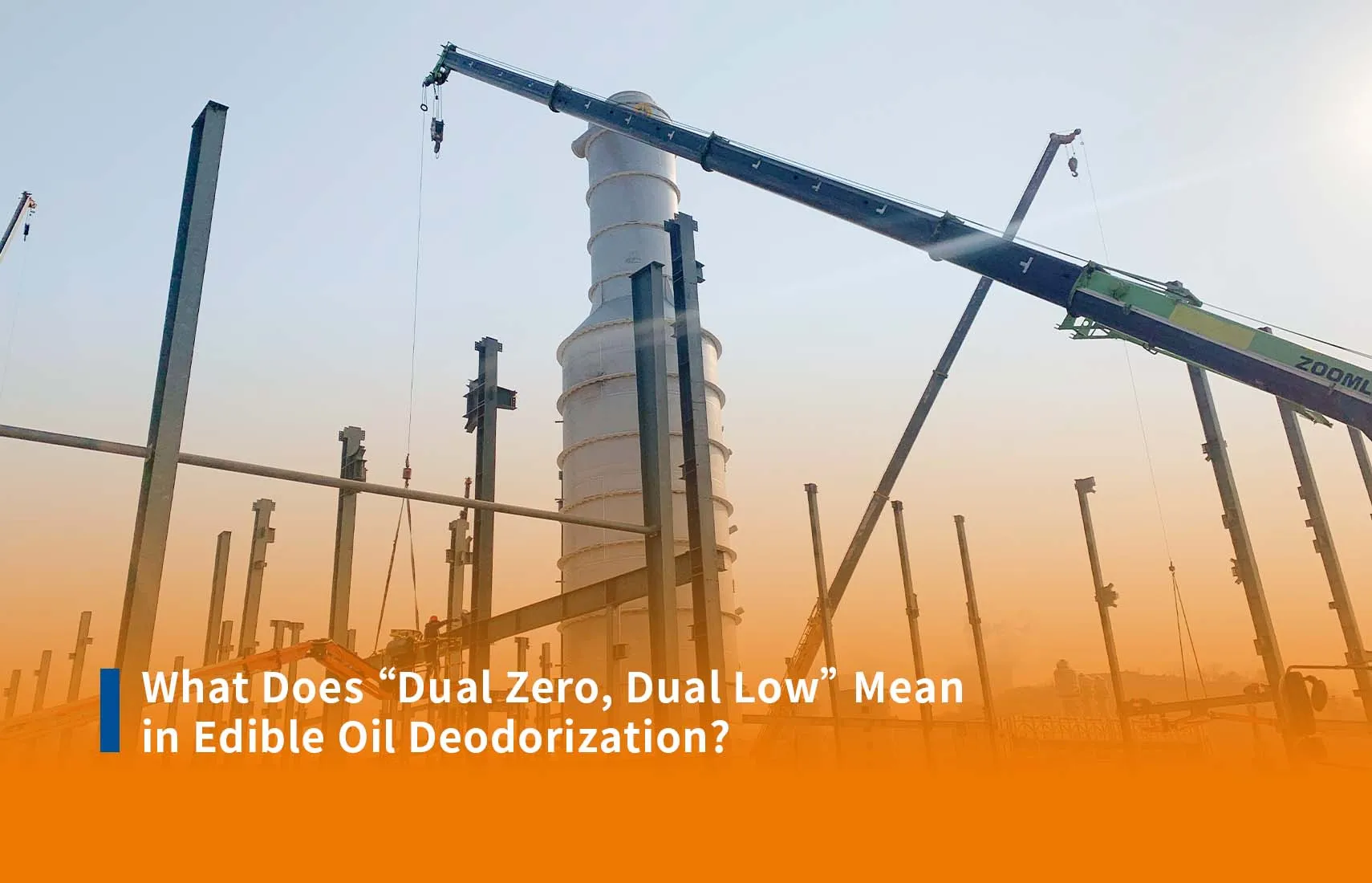
“Dual Zero, Dual Low” is a term developed by Myande to describe its approach to modern edible oil deodorization.
But what do the “zero” and “low” actually refer to?
The concept focuses on two key aspects of deodorization: energy efficiency and oil quality.
At a Glance
|
Dual Zero |
Dual Low |
|
Lower deodorization temperature |
Low TFA |
|
Shorter deodorization time |
Low GEs & Low 3-MCPDE |
What Does “Dual Zero” Mean?
“Dual Zero” refers to the significant reduction of two key deodorization parameters: temperature and processing time.
By optimizing deodorization conditions, the process can operate at a lower temperature and for a shorter residence time. This helps reduce thermal exposure while maintaining effective deodorization performance.
The approach is further supported by more than 80% heat recovery efficiency and zero steam consumption in the vacuum system, helping reduce overall energy consumption.
In simple terms:
Dual Zero = Lower temperature + Shorter time
with energy-saving performance supported by:
More than 80% heat recovery efficiency + Zero steam consumption in the vacuum system
What Does “Dual Low” Mean?
“Dual Low” focuses on two key quality targets in refined edible oil.
The first is low trans fatty acids (TFA).
The second is the control of glycidyl esters (GEs) and 3-monochloropropane-1,2-diol esters (3-MCPDE), two process contaminants that are closely associated with high-temperature processing of edible oils.
In simple terms:
Dual Low = Low TFA + Low GEs & 3-MCPDE
The objective is to control these undesirable substances while maintaining the required quality of the refined oil and meeting applicable regulatory requirements.
Why Does It Matter?
Deodorization has traditionally relied on high temperature, vacuum, and steam stripping to remove unwanted odors and flavors from edible oils. However, excessive thermal exposure can increase energy consumption and affect oil quality.
This creates a challenge for modern oil processors:
How can deodorization be made more energy-efficient while maintaining high oil quality?
The answer is not simply to lower the temperature. Temperature, processing time, vacuum conditions, steam consumption, heat recovery, and process control all need to work together.
This is the thinking behind Dual Zero, Dual Low.
Ultimately, Dual Zero, Dual Low reflects a simple direction for modern edible oil deodorization: use less energy while maintaining high-quality refined oil.
For Myande, it represents an approach to optimizing the deodorization process as a whole, balancing energy efficiency, process performance, and oil quality.

Recent Posts

October 26, 2016
The Most Successful Engineering Contractor


Aug 14, 2026
Large-Scale Edible Oil Plants: What You Should Know


Aug 04, 2026
How to Choose Starch Sweetener Processing Equipment?Contact Us
Product Information
Quantity
Unit
Piece
Support order samples, customization, wholesale direct, and complete payment. If the product you look for does not have corresponding customized content, pls fill out the form below to contact us, and we will reply ASAP.