
Turning Industrial Wastewater into a Resource: How Triple-Effect Evaporation Enables Zero Liquid Discharge?
Jul 27, 2026

The final stage of industrial wastewater treatment can often be one of the most challenging. For companies facing increasingly stringent environmental requirements, however, wastewater treatment is no longer simply a compliance issue. With the right technology, dissolved salts and other components in wastewater can be recovered as usable products, while treated water can be recycled within the plant.
This is where evaporation and crystallization technology can play an important role.
Myande Group Co., Ltd. specializes in industrial evaporation and crystallization systems for challenging wastewater treatment applications. Its triple-effect evaporator systems are designed for industries such as chemicals, pharmaceuticals, pesticides, and new energy, helping customers reduce steam consumption, recover valuable salts, and achieve zero liquid discharge (ZLD).
How Does a Triple-Effect Evaporator Improve Energy Efficiency?
Evaporation is an energy-intensive process, particularly when treating large volumes of wastewater. A key advantage of a triple-effect evaporator is its ability to reuse thermal energy across multiple evaporation stages.
Myande’s triple-effect evaporator uses a multi-effect configuration to recover and reuse heat from one stage in subsequent stages. As a result, steam consumption can be reduced to approximately 30% of that of a comparable single-effect evaporation system.
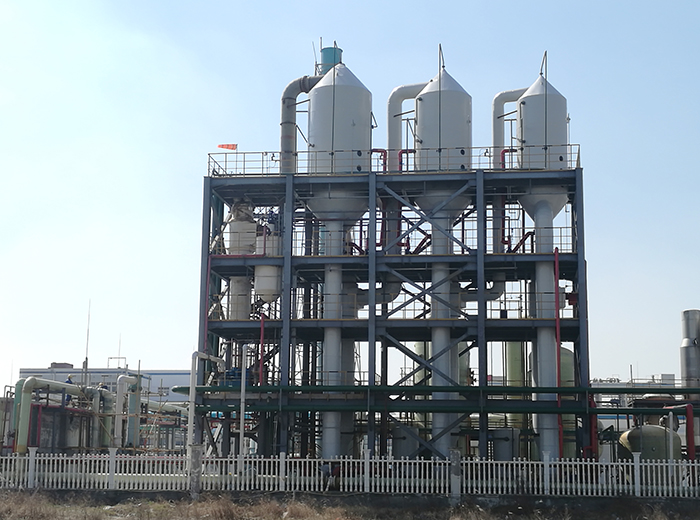
This approach provides a more economical option for treating high-salt wastewater with complex compositions and large processing volumes.
Myande’s evaporation technology is supported by a dedicated R&D team of more than 100 engineers and specialists focused on evaporation, concentration, and crystallization technologies. Continuous process development allows the company to adapt evaporation systems to different wastewater compositions and operating requirements.
How Can Triple-Effect Evaporation Treat Complex Industrial Wastewater?
Industrial wastewater can contain high concentrations of inorganic salts, organic compounds, and other substances that make conventional treatment methods difficult or costly.
Evaporation and crystallization can provide an alternative approach by separating water from dissolved solids and recovering salts in solid form.
A representative example is a project for a pesticide manufacturer in Shandong, China. The project involved a triple-effect evaporation and crystallization system for wastewater containing high concentrations of sodium chloride and significant levels of organic matter.
The wastewater presented several treatment challenges, requiring extensive testing and process evaluation before the final system configuration was selected.
Myande developed a combined pretreatment + triple-effect evaporation and crystallization process.
The pretreatment stage was designed to stabilize the wastewater before it entered the evaporation system. The triple-effect evaporator then concentrated the wastewater, while solid-liquid separation enabled sodium chloride and other salts to be crystallized and removed from the process.
The recovered sodium chloride was produced as industrial-grade salt, while the condensate generated during evaporation was fully recovered for reuse.
The integrated process enabled the project to achieve zero liquid discharge, while converting part of the wastewater's dissolved salt content into a usable product.
What Is the Role of Pretreatment in Industrial Wastewater Evaporation?
Pretreatment is particularly important when an evaporation system handles wastewater containing high levels of organic matter, suspended solids, or other substances that may affect heat transfer and system stability.
A properly designed pretreatment stage can reduce the load on downstream evaporation equipment and help create more stable operating conditions.
For complex wastewater applications, Myande evaluates wastewater characteristics through laboratory testing and process trials before developing the final process configuration. This approach helps determine appropriate pretreatment methods, evaporation conditions, crystallization parameters, and solid-liquid separation requirements.
The objective is not simply to evaporate wastewater, but to design a complete treatment process around the characteristics of the customer's wastewater.
How Does Myande Support Reliable Evaporation System Operation?
Energy efficiency is only one consideration when selecting industrial evaporation equipment. Long-term operating stability, resistance to fouling, equipment quality, and automation are equally important for continuous industrial production.
Myande operates an intelligent manufacturing facility covering more than 130,000 square meters, supporting in-house production of key evaporation equipment.
The company also holds international certifications and standards including ISO 9001, ASME, and CE, supporting quality control throughout equipment manufacturing and project execution.
By integrating process engineering, equipment design, manufacturing, and quality management, Myande aims to maintain stable heat-transfer performance and long-term equipment reliability in demanding industrial applications.
How Does 3D Engineering Improve Industrial Evaporation Projects?
Large evaporation and crystallization systems involve complex arrangements of equipment, piping, utilities, and supporting structures. Errors in equipment placement or piping design can lead to costly modifications during construction.
Myande uses advanced 3D engineering tools during the design stage to visualize the complete system before construction begins. This allows engineers to identify potential layout conflicts, optimize equipment and piping arrangements, and generate more accurate material and piping lists.
The approach can reduce construction errors, improve material planning, and help control project costs.
Myande’s civil engineering team also provides detailed engineering drawings and technical information to support coordination between equipment design and site construction.

Can an Industrial Evaporation System Operate Automatically?
Automation is another important factor in modern wastewater treatment plants.
Myande’s control systems are designed to support automated operation of evaporation equipment, including startup, shutdown, cleaning, and routine operating sequences.
Depending on the project requirements, the control system can be configured for fully automatic, semi-automatic, or manual operation.
For fully automated systems, operators can initiate key process sequences with minimal manual intervention. Automated cleaning functions can also help maintain equipment performance and reduce the need for routine on-site intervention.
This supports the development of unattended or low-intervention evaporation systems, particularly for industrial facilities seeking to improve operational efficiency.
Which Industries Can Use Triple-Effect Evaporation Technology?
Industrial evaporation and crystallization systems can be applied across a wide range of industries where wastewater contains high concentrations of dissolved solids or valuable recoverable materials.
Myande provides evaporation solutions for applications including:
🔸Chemical processing
🔸New energy and battery-related industries
🔸Pesticide manufacturing
🔸Pharmaceutical production
🔸Food processing
🔸Other high-salt and complex industrial wastewater applications
Depending on the wastewater characteristics and project objectives, the overall solution can include process package development, laboratory testing, process design, equipment manufacturing, installation, commissioning, and technical support.
How Can Zero Liquid Discharge Create Additional Value?
For industrial companies, zero liquid discharge is increasingly becoming an important wastewater management strategy, particularly where wastewater discharge is restricted or water reuse is a priority.
An effective ZLD system should do more than simply eliminate liquid discharge. It should also consider energy consumption, salt recovery, condensate reuse, equipment reliability, and the overall economics of plant operation.
Triple-effect evaporation and crystallization can address several of these requirements within an integrated process.
By concentrating wastewater, recovering salts as solid products, and recycling condensate, the process can reduce liquid waste while increasing opportunities for water and material recovery.
The result is a shift from wastewater treatment as a purely cost-driven activity toward a more resource-efficient approach to industrial production.
What Should Companies Consider When Choosing an Industrial Evaporation System?
For companies evaluating evaporation equipment for industrial wastewater treatment, several factors should be considered before selecting a system:
1. Wastewater composition – What are the concentrations of salts, organic matter, suspended solids, and other components?
2. Required treatment capacity – How much wastewater needs to be processed per day?
3. Energy consumption – How effectively can thermal energy be recovered and reused?
4. Fouling and scaling control – How will the system maintain stable heat-transfer performance over extended operation?
5. Salt recovery – Can dissolved salts be recovered as usable products?
6. Water reuse – Can condensate be recovered and returned to the production process?
7. Automation requirements – What level of automatic operation and remote monitoring is required?
8. Engineering and manufacturing capability – Can the supplier provide process design, equipment manufacturing, installation, commissioning, and technical support as an integrated solution?
These considerations are particularly important for complex wastewater applications, where equipment performance depends heavily on the characteristics of the feed material and the overall process configuration.
Building More Efficient Industrial Wastewater Treatment Systems
Industrial wastewater treatment is becoming increasingly connected with resource recovery, energy efficiency, and water reuse.
For challenging high-salt wastewater applications, triple-effect evaporation and crystallization can provide a practical route to reducing liquid discharge while recovering salts and reusable water.
Myande combines process development, evaporation and crystallization technology, equipment manufacturing, engineering design, automation, and project implementation to develop integrated solutions for industrial wastewater treatment.
With experience across chemical, new energy, pesticide, pharmaceutical, food, and other industries, Myande continues to develop evaporation technologies that help industrial customers reduce wastewater discharge, improve resource recovery, and build more efficient and sustainable production facilities.


Recent Posts

October 26, 2016
The Most Successful Engineering Contractor




Contact Us
Product Information
Quantity
Unit
Piece
Support order samples, customization, wholesale direct, and complete payment. If the product you look for does not have corresponding customized content, pls fill out the form below to contact us, and we will reply ASAP.