
Why Large Soybean Oil Plants Use Solvent Extraction Technology?
Aug 31, 2026
Solvent extraction technology is often considered when a soybean crushing project reaches industrial scale, but capacity alone does not make it the right choice. We see that investors can face higher oil-loss exposure, uneven process interfaces, and difficult operating decisions when they compare only equipment prices. A properly evaluated integrated route provides a clearer basis for long-term investment.
Large soybean oil plants use solvent extraction technology when an integrated preparation–extraction route offers an acceptable balance of oil recovery, continuous throughput, operating cost, safety management, environmental control, and project risk. It is not automatically the best choice for every large plant. Owners should evaluate the complete process—from soybean preparation and pressing to solvent recovery, desolventizing, refining, automation, and compliance—before selecting a route.
At Myande, we approach this decision as an engineering and lifecycle question rather than a single-machine purchase. In our experience supporting large oilseed projects, the strongest investment decisions begin with the owner’s feedstock, product plan, energy conditions, operating capability, and risk tolerance—not with a simplistic comparison between pressing and extraction.
Why Does Solvent Extraction Technology Fit Many Large Soybean Plants?
Large soybean plants often need stable, high-volume production with careful control of oil recovery and operating cost. If a plant relies on an incomplete process comparison, it may underestimate the value of continuous material flow and integrated energy management. Solvent extraction technology can address these needs, but only when the complete production system is properly designed and operated.
Solvent extraction technology fits many large soybean plants because it can be integrated with preparation to create a continuous process route that supports high throughput and efficient oil recovery. Its value comes from the interaction of equipment, process controls, solvent handling, energy recovery, and downstream refining—not from extraction equipment alone.
Solvent Extraction Is a Process Route, Not a Standalone Machine
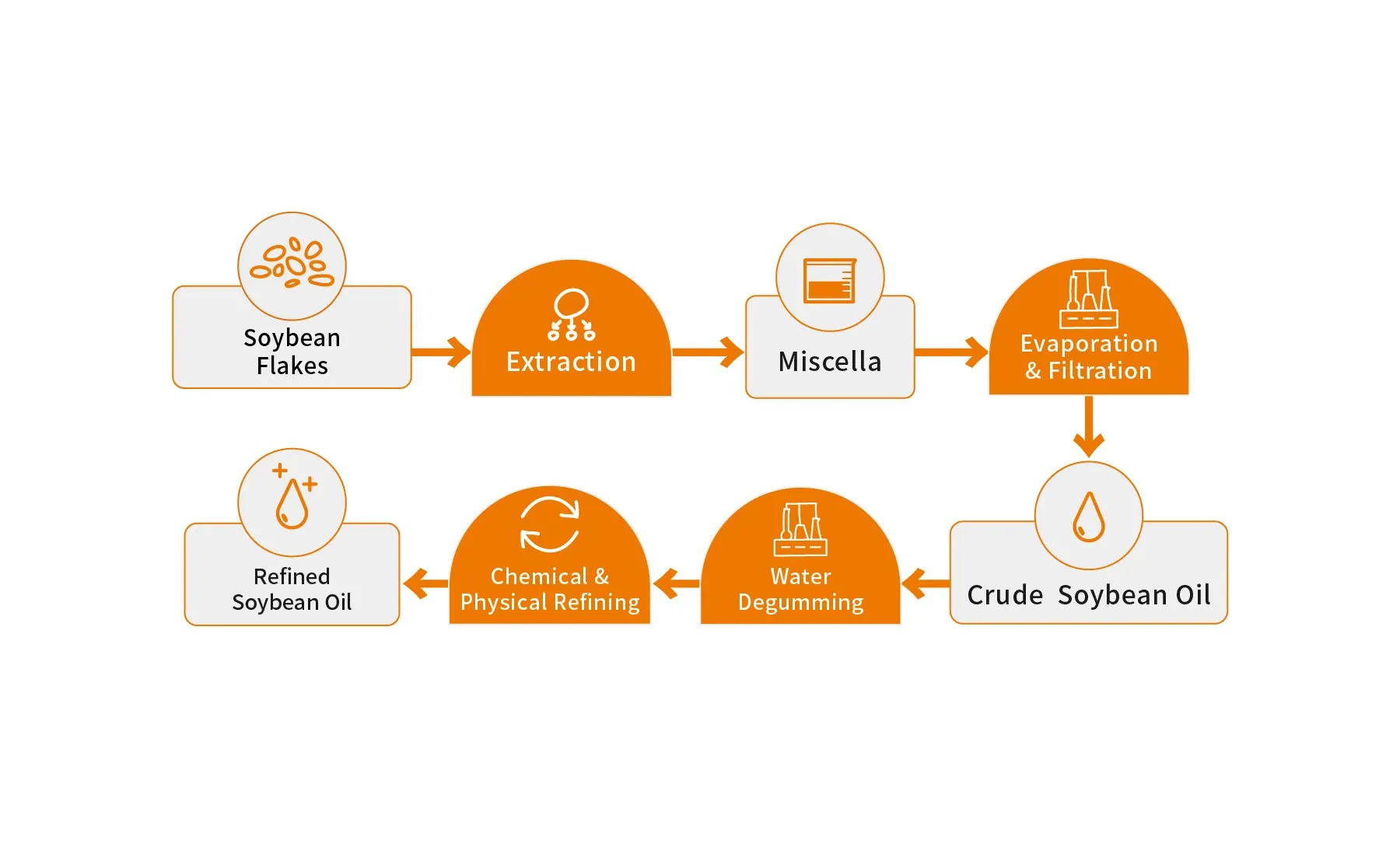
We believe buyers should avoid viewing extraction as a single equipment category. A soybean preparation–extraction facility is a connected process system. Each area affects the next, and weak interfaces can reduce the practical value of otherwise capable equipment.
A typical integrated route includes:
1. Soybean receiving, cleaning, and storage
The plant must protect raw-material quality and provide stable feed conditions. Storage capacity, cleaning efficiency, foreign-material control, and logistics all influence production continuity.
2. Preparation
Processes such as conditioning, cracking, flaking, and expanding help establish the physical conditions required for efficient pressing and extraction. The appropriate configuration depends on soybean quality, local practices, meal specifications, and plant objectives.
3. Extraction
The extraction system contacts prepared material with solvent in a controlled environment. The process must manage miscella flow, bed permeability, residence time, sealing, temperature, and solvent circulation.
4. Desolventizing and meal treatment
The desolventizer-toaster, dryer, cooler, and related meal-handling equipment must achieve the plant’s meal requirements while supporting responsible solvent removal and energy use.
5. Solvent recovery and vapor management
Condensation, recovery, vacuum systems, vent treatment, and closed-loop solvent handling are central to safety, environmental performance, and operating economics.
6. Crude oil handling and refining integration
Crude soybean oil quality, degumming strategy, refining route, and final product targets should be considered early. Extraction does not operate in isolation from refining.
We have learned through project discussions that a plant can have technically sound individual machines and still underperform if process interfaces, control logic, utilities, or commissioning plans are not aligned.
Why Scale Can Change the Evaluation
At greater capacities, small process losses or interruptions can become commercially meaningful over time. This does not mean that every large plant must choose extraction. It means that large plants usually have more reason to examine lifecycle effects in detail.
For example, owners may need to consider:
🔸Whether continuous production supports their annual operating plan
🔸Whether the local energy system can support steam, cooling water, power, and vacuum requirements
🔸Whether qualified personnel are available to manage solvent-related operations
🔸Whether the plant needs meal characteristics aligned with specific feed markets
🔸Whether the project has sufficient infrastructure for solvent storage, fire protection, emissions management, and process safety systems
🔸Whether the owner expects future expansion, debottlenecking, or refining integration
At Myande, our publicly communicated large oilseed project experience includes integrated preparation, extraction, desolventizing, automation, and utility-related systems. For example, our Brazilian soybean processing project included a 3,000-tonne-per-day soybean preparation system, together with related oil-processing configurations. Such project configurations demonstrate the level of integration investors need to assess. They should not be treated as a universal performance guarantee, because actual outcomes depend on feedstock, operating conditions, project scope, and site management.
How Should Owners Compare Solvent Extraction Technology With Other Routes?
Investors can make poor decisions when they compare the purchase price of an extractor with the purchase price of pressing equipment. That approach can overlook utilities, maintenance, oil losses, compliance systems, civil works, automation, and the cost of downtime. We recommend comparing complete operating scenarios instead of comparing isolated equipment quotations.
Owners should compare solvent extraction technology with alternative routes through a whole-plant lifecycle model. The evaluation should include capital scope, residual oil targets, utility demand, operating labor, maintenance, safety systems, emissions controls, refining needs, uptime expectations, and supplier execution capability. A lower initial equipment price may not represent the lowest lifecycle cost.
Use a Whole-Plant Cost Model
A meaningful procurement evaluation should define what is included in each supplier’s scope. One supplier may quote process equipment only, while another may include automation, engineering, installation support, heat recovery, solvent recovery equipment, training, and commissioning assistance. These proposals are not directly comparable until the boundaries are clear.
We suggest that owners create a common technical and commercial comparison sheet.
| Evaluation area | Questions for the project team | Why it matters |
| Process route | Is the proposal full pressing, pre-pressing–extraction, or another hybrid configuration? | The selected route affects oil recovery, meal handling, utilities, and operating complexity |
| Feedstock | What soybean quality range, moisture range, foreign-material level, and storage condition are expected? | Feedstock variation can affect preparation, extraction stability, and product quality |
| Utilities | What are the stated steam, power, cooling-water, compressed-air, and vacuum requirements? | Utility demand affects both operating costs and infrastructure investment. |
| Solvent system | What closed handling, recovery, monitoring, and emergency systems are included? | These systems are critical to safe and compliant operation. |
| Automation | Which control functions, interlocks, alarms, historian systems, and reporting tools are included? | Automation supports process consistency but must match the owner’s operating model. |
| Maintenance | Which wear parts, inspection points, access platforms, and maintenance plans are specified? | Maintainability influences uptime and total ownership cost |
| Delivery | Who is responsible for design interfaces, manufacturing, site installation, commissioning, and training? | Clear responsibility reduces schedule and coordination risk |
| Guarantees | Which results are contractually defined, under what test conditions, and with what exclusions? | Guarantees must be measurable and linked to agreed operating conditions. |
Do Not Treat Residual Oil as the Only Metric
Oil recovery is important, but it is not the only indicator of plant value. We encourage investors to consider a broader set of operating outcomes:
🔸Stability: Can the plant sustain a controlled operating condition across normal feedstock variation?
🔸Meal quality: Does the route support the intended protein-feed market and customer specifications?
🔸Energy integration: Does the system use available heat effectively, and can it be integrated with site-wide utilities?
🔸Maintenance access: Can the operating team inspect, clean, and maintain critical components without excessive downtime?
🔸Control readiness: Are the process control strategy and safety interlocks understandable for the owner’s operators?
🔸Expansion flexibility: Can the design accommodate future capacity increases or downstream processing additions?
🔸Supplier support: Does the supplier have proven project-management, commissioning, spare-parts, and training capabilities?
I have seen project meetings shift quickly once owners begin asking these questions. The discussion moves away from “Which machine costs less?” and toward “Which route gives us the most manageable operating model over the life of this asset?” That is the more useful question for a major capital project.
Consider Energy Integration Early
Energy demand should be assessed at the system level. Extraction plants include thermal and mechanical duties across preparation, desolventizing, solvent recovery, drying, cooling, and refining. The actual energy profile depends on equipment selection, plant layout, local utilities, heat-integration opportunities, throughput, and operating practices.
Myande has developed and supplied energy-recovery solutions in oilseed processing applications, including desolventizer heat-recovery configurations. In a publicly reported retrofit at Guangxi Gangqing Oils & Fats Co., Ltd., the project integrated technologies such as thermal vapor recompression, negative-pressure draining, and preparation workshop waste-heat recovery. Reported results for that specific site included a reduction of 22 kg of steam per tonne of soybeans in the preparation workshop.
The practical lesson is simple: owners should ask suppliers to explain the energy balance, the assumptions behind it, and the operational conditions required to achieve it.
How Do Large Plants Control Hexane and Solvent-Related Risks?
Hexane-related concerns are valid because solvent extraction introduces hazards and compliance responsibilities that owners must manage carefully. A plant cannot address these concerns with a single statement about final oil quality. Safe operation depends on integrated engineering, disciplined procedures, monitoring, maintenance, training, and compliance with applicable local requirements.
Large plants control solvent-related risks through an integrated system of closed solvent handling, vapor recovery, desolventizing, process monitoring, electrical-area classification, fire protection, operating procedures, maintenance, and regulatory compliance. Solvent extraction technology requires competent engineering and trained operation; automation alone does not make a facility safe.
Food Safety and Process Safety Are Connected but Different
We recommend separating two questions that are often combined:
1. How does the facility manage solvent in the process?
2. How does the facility ensure that oil and meal meet applicable product and regulatory requirements?
The first question involves containment, recovery, ventilation, monitoring, equipment integrity, ignition-source control, and emergency response. The second involves validated process conditions, testing, downstream refining where applicable, quality systems, documentation, and compliance with the regulations that apply in the target market.
It would be inaccurate to say that solvent is inherently harmless. It would also be inaccurate to assume that a large or automated plant is automatically safe. Scale can increase the importance of robust design and operating discipline because it increases the consequences of poor control.
What Buyers Should Review in a Solvent Safety Package
Before selecting a supplier, we recommend that owners request a documented review of the proposed solvent-management and process-safety scope.
Key review areas include:
🔸Closed-loop solvent circulation and recovery design
🔸Extractor sealing and leak-prevention approach
🔸Vapor condensation, recovery, and vent-treatment arrangements
🔸Desolventizing process design and control philosophy
🔸Hazardous-area electrical classification
🔸Grounding, bonding, and static-control measures
🔸Gas detection and alarm systems
🔸Fire and explosion protection systems
🔸Emergency shutdown logic and interlocks
🔸Pressure-relief and venting philosophy
🔸Operator training and standard operating procedures
🔸Preventive maintenance and inspection requirements
🔸Applicable environmental, occupational, fire, and food regulations
A credible supplier should explain what it supplies, what the owner or local engineering partner must provide, and which decisions require local regulatory review. Certifications, licenses, and compliance documents should be verified by the buyer for the specific project jurisdiction. They should not be accepted as generic proof that every future facility will meet every local requirement.
Automation Supports Control, but It Does Not Replace Competence
Digital controls can make complex plants more visible and manageable. For example, a supervisory control system can provide trend data, alarm management, equipment status, production reporting, and historical records. Advanced maintenance platforms can also help maintenance teams identify equipment conditions before they cause unplanned stops.
Myande’s intelligent solutions include the iMRO equipment-maintenance system, which combines equipment information, maintenance standards, workflow planning, IoT monitoring, and predictive algorithms. In the appropriate application, this kind of system can support a transition from reactive maintenance toward planned maintenance. Still, we would not describe any digital platform as a substitute for trained operators, sound mechanical integrity practices, or qualified safety professionals.
For an application-specific solvent-risk assessment, owners should involve qualified process-safety, environmental, regulatory, and food-safety professionals. This is especially important when a project crosses jurisdictions or introduces new operating teams.
When May Solvent Extraction Technology Not Be the Best Choice?
Many investors assume that a new large soybean project should use extraction because the industry commonly uses it at scale. That assumption can create unnecessary complexity if the site lacks the right operating conditions, regulatory pathway, energy infrastructure, or management capability. A good process route must fit the owner’s business model as well as the production target.
Solvent extraction technology may not be the best choice when plant scale, feedstock conditions, product mix, local utilities, permitting requirements, capital constraints, operating capability, or project schedule do not support a complex integrated solvent facility. Owners should select the route that best fits their verified commercial and technical conditions.
Circumstances That Require Extra Caution
We recommend closer analysis when one or more of the following conditions apply:
🔸The owner plans a smaller or highly seasonal operation.
🔸The site has limited access to reliable steam, cooling water, power, or technical maintenance support.
🔸The operating organization has limited experience with solvent systems.
🔸Local permitting, environmental requirements, or hazardous-material regulations introduce substantial uncertainty.
🔸The business model prioritizes a specialty product with a different processing route.
🔸The project requires an unusually short implementation timeline.
🔸The site has restricted space for solvent storage, recovery, safety distances, or supporting infrastructure.
🔸The owner cannot commit to the required training, inspection, maintenance, and process-safety management systems.
None of these factors automatically disqualifies extraction. They simply mean that the investment case needs more scrutiny.
Pressing and Extraction Are Not Simplistic Opposites
We often see discussions framed as “mechanical pressing versus solvent extraction.” In practice, large soybean plants may evaluate integrated preparation–extraction routes, which use both mechanical and solvent-based stages. The right question is not which technology wins in the abstract. The question is how the route supports the owner’s desired balance of oil recovery, meal characteristics, plant complexity, operating cost, and risk.
| Route consideration | Full pressing focus | Integrated preparation–extraction focus |
| Process complexity | Generally lower, though configuration still matters | Higher due to solvent handling and recovery systems |
| Solvent management | Not a core operating requirement | Requires dedicated process-safety and compliance controls |
| Oil recovery strategy | Relies primarily on mechanical separation | Combines mechanical preparation with extraction |
| Utility and infrastructure needs | Depends on design and downstream scope | Requires detailed assessment of thermal, recovery, and safety systems |
| Operator capability | Requires trained operators and maintenance staff | Requires additional solvent-system competence and formal safety discipline |
| Evaluation method | Compare complete process and product objectives | Compare complete process and product objectives |
This table is not a recommendation for either route. Each project requires a site-specific feasibility study, mass and energy balance review, financial model, and regulatory assessment.
Supplier Selection Can Determine Project Risk
For a solvent-based project, supplier selection should extend beyond equipment fabrication. Owners should assess whether a potential partner can coordinate process design, equipment manufacturing, controls, site interfaces, installation support, commissioning, and training.
At Myande, our core capability is to provide system-oriented engineering solutions across planning, design, research and development, equipment manufacturing, intelligent control, installation, commissioning guidance, and personnel training. We have delivered more than 1,600 projects across relevant industrial sectors. Still, buyers should validate the scope, references, contractual responsibilities, and project suitability for their own investment rather than relying on corporate scale alone.
A capable supplier evaluation process should include:
1. Reference checks for comparable process scope and project scale
2. A review of the proposed project team and interface-management method
3. Clear definition of process guarantees and test conditions
4. Documentation of safety, automation, and maintenance philosophies
5. A realistic commissioning and operator-training plan
6. Verification of local compliance responsibilities
7. A lifecycle spare-parts and service strategy
Frequently Asked Questions
1. Is solvent extraction technology necessary for every large soybean oil plant?
No. Solvent extraction technology is not necessary for every large soybean oil plant. Its suitability depends on production scale, feedstock conditions, oil and meal targets, utility availability, regulations, capital plan, operator capability, and the owner’s willingness to manage a more complex solvent-based process system.
2. Is hexane safe in soybean oil extraction?
Hexane requires strict management because it is a flammable processing solvent and raises legitimate safety and compliance concerns. A safe approach relies on closed handling, recovery, desolventizing, refining where applicable, monitoring, maintenance, trained personnel, and compliance with local regulations. Each facility needs qualified professional evaluation.
3. What should investors compare when selecting an extraction supplier?
Investors should compare more than equipment price. They should assess process design, utility assumptions, solvent recovery, safety systems, automation, maintenance access, project-management capacity, commissioning support, training, guarantees, reference projects, spare-parts planning, and the supplier’s ability to manage system interfaces.
4. Can automation improve solvent extraction plant reliability?
Automation can improve visibility, consistency, alarm management, data collection, and maintenance planning. However, automation cannot replace a sound process design, mechanical integrity program, trained operators, or process-safety management. Reliability comes from the combined performance of people, procedures, equipment, and controls.
Conclusion
Large soybean oil plants use solvent extraction technology when it supports a well-founded whole-plant strategy—not simply because the plant is large. We recommend that investors evaluate integrated preparation, extraction, solvent recovery, desolventizing, refining, utilities, safety, automation, and supplier execution as one connected decision. The right route must fit the site, feedstock, market, regulations, and operating organization. If you are planning a soybean crushing project or capacity upgrade, our Myande team can help you assess process-route options and develop a practical, system-level engineering plan.

Recent Posts

October 26, 2016
The Most Successful Engineering Contractor



Aug 14, 2026
Large-Scale Edible Oil Plants: What You Should KnowContact Us
Product Information
Quantity
Unit
Piece
Support order samples, customization, wholesale direct, and complete payment. If the product you look for does not have corresponding customized content, pls fill out the form below to contact us, and we will reply ASAP.