

Corn Starch Production Process: A Complete Step-by-Step Guide
Sep 17, 2026
The corn starch production process can look simple on paper, yet many investors underestimate its integration challenges. A weak process route can reduce starch quality, waste coproducts, increase water and energy consumption, and create unstable operation. I have found that the best solution begins with raw material, product, utility, and market requirements—not with a standard equipment list.
The corn starch production process normally includes corn receiving, cleaning, steeping, milling, germ separation, fiber and protein separation, starch washing, dewatering, drying, and coproduct handling. However, the correct configuration depends on corn quality, plant capacity, product specifications, utilities, coproduct markets, and future expansion plans. Buyers should validate the process design through project-specific engineering and professional technical evaluation.
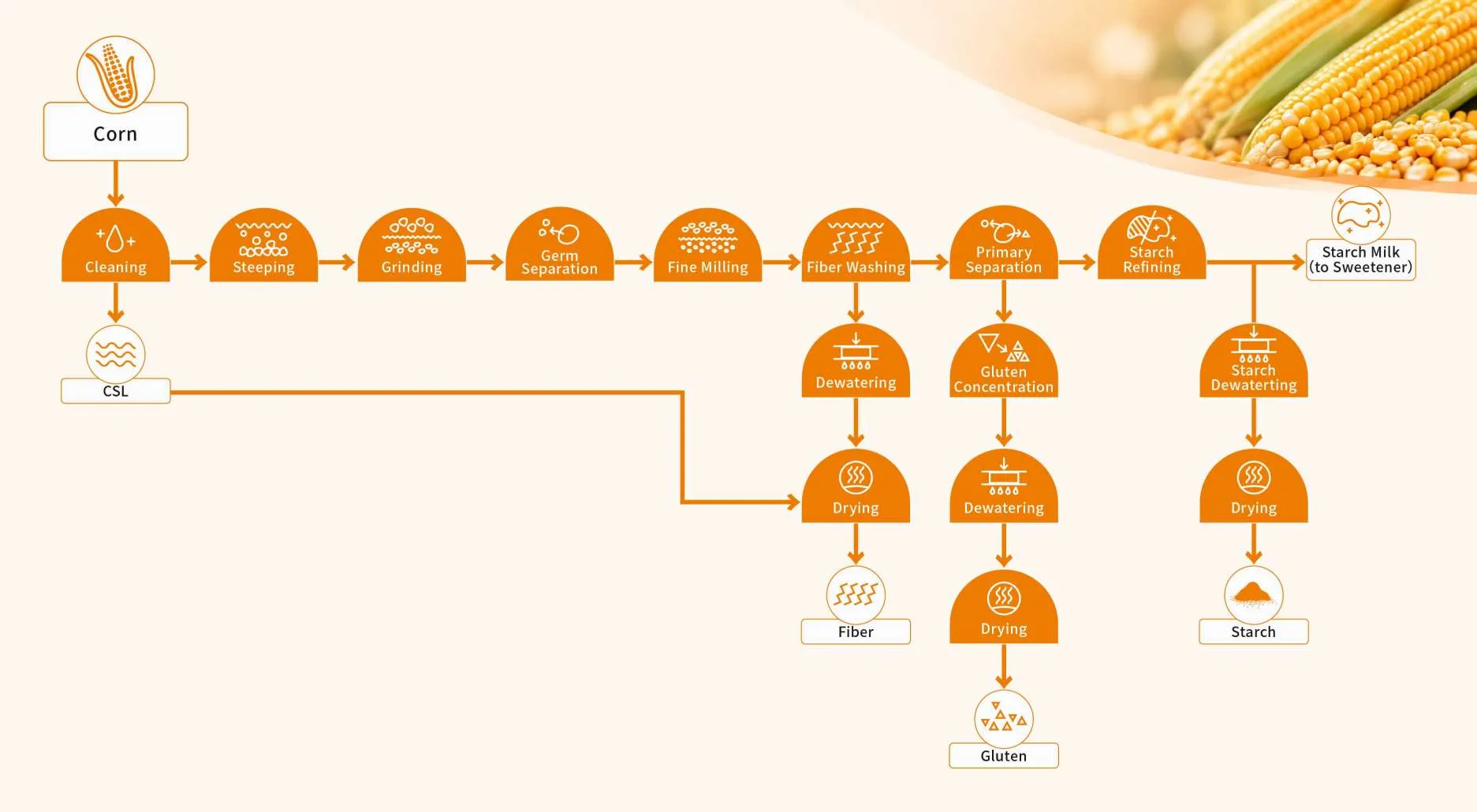
A process flow diagram provides a useful starting point, but it does not represent a complete plant design. I usually examine each stage through two questions: what function does the stage perform, and how does its design affect product value, operating cost, and stability? The following sections explain that decision logic.
How does the corn starch production process begin with raw material preparation?
Poor raw material preparation can create problems that appear much later in separation and washing. If the corn contains excessive foreign material, inconsistent moisture, damaged kernels, or unsuitable storage residues, the plant may face unstable milling and variable product quality. I treat preparation as a quality-control stage, not as a minor pre-treatment step.
The first stages normally include receiving, weighing, sampling, cleaning, impurity removal, storage, and controlled feeding. The detailed arrangement depends on the corn supply chain and local storage conditions.
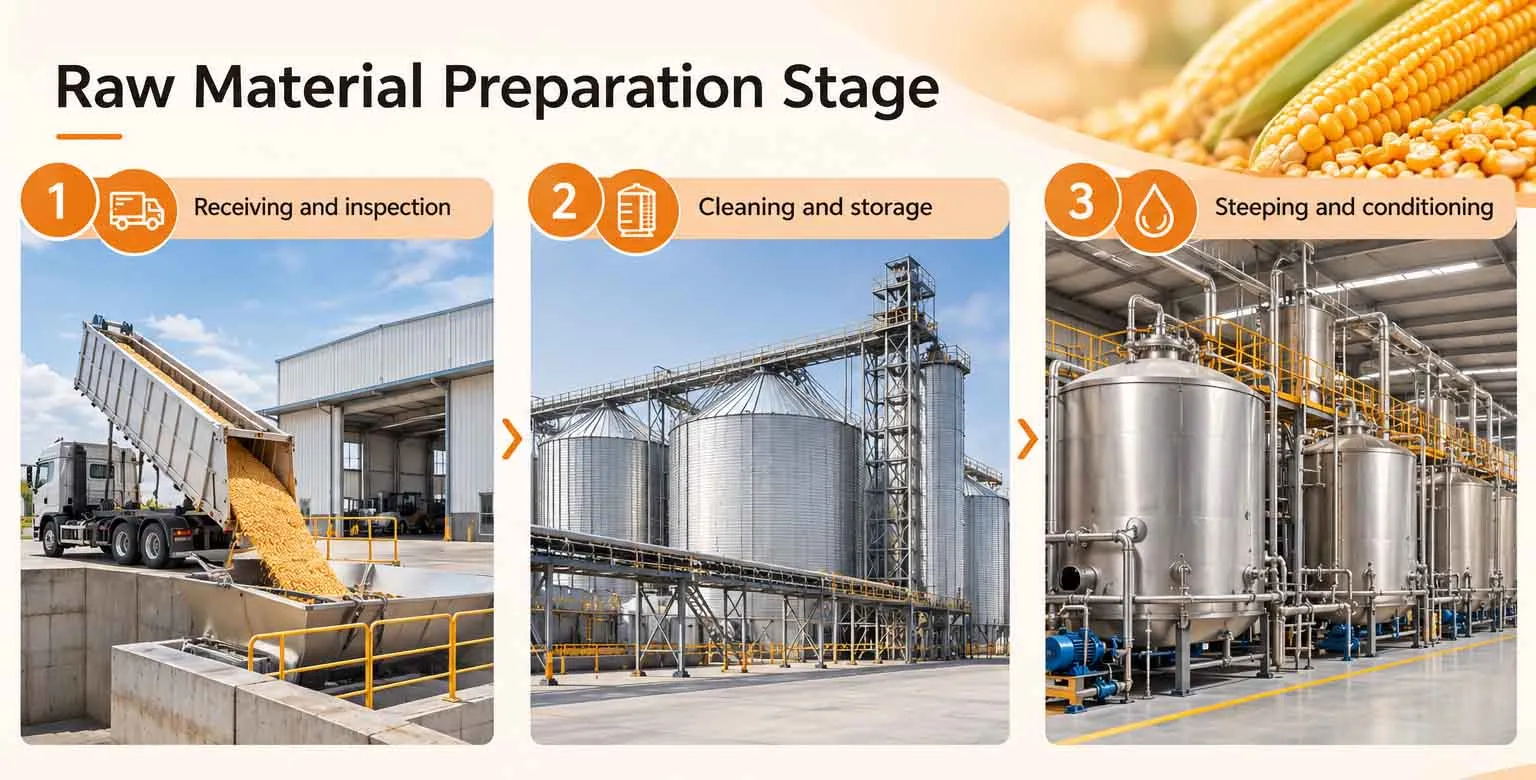
Receiving and inspection
I would normally recommend defining a raw material specification before selecting the main process equipment. The specification may address:
🔸Moisture content
🔸Foreign material
🔸Broken or damaged kernels
🔸Mold or contamination risks
🔸Kernel size and hardness
🔸Storage age
🔸Seasonal variation
🔸Expected supply consistency
These factors influence the effectiveness of steeping and milling. A plant that receives corn from several regions may need more flexible operating control than a plant with one stable supplier.
Cleaning and storage
Cleaning removes stones, metals, dust, cobs, and other unwanted materials. Magnets, screens, aspiration systems, and related devices may be selected according to the contamination profile. I would not treat the equipment arrangement as universal because local harvesting and transport practices can differ significantly.
Storage also affects production continuity. The design team should consider silo capacity, aeration, temperature monitoring, pest control, and first-in-first-out management. A plant with insufficient storage may experience frequent interruptions when deliveries are delayed. A plant with poorly controlled storage may process degraded corn even when the original purchase quality was acceptable.
Steeping and conditioning
Steeping softens the kernel and supports later separation. In a wet-milling route, the corn is held in water under controlled conditions, often with process chemicals selected for the intended route. The exact residence time, temperature, chemical concentration, and circulation arrangement require project-specific validation.
I have seen customer discussions become too focused on the nameplate capacity of a steeping system. In practice, the more important questions include:
1. Can the system handle seasonal corn variation?
2. Can operators control residence time consistently?
3. Can the plant manage steepwater and dissolved solids?
4. Does the design support cleaning and maintenance?
5. Can the route support future coproduct or downstream plans?
Steepwater can contain soluble materials with potential value, but its treatment and recovery must be evaluated together with environmental requirements and the overall coproduct strategy.
What happens during milling and separation in a corn starch production process?
Milling releases the main components of the kernel so that the plant can separate germ, fiber, protein, and starch. The plant must achieve effective separation without creating excessive fines, contamination, or product loss. I view this section as the technical core of the corn starch production process because decisions here directly affect recovery and downstream purification.
The typical route uses controlled milling followed by germ separation, fiber separation, gluten or protein separation, and starch washing. The exact sequence and recirculation loops vary with capacity, corn characteristics, product specifications, and coproduct objectives.
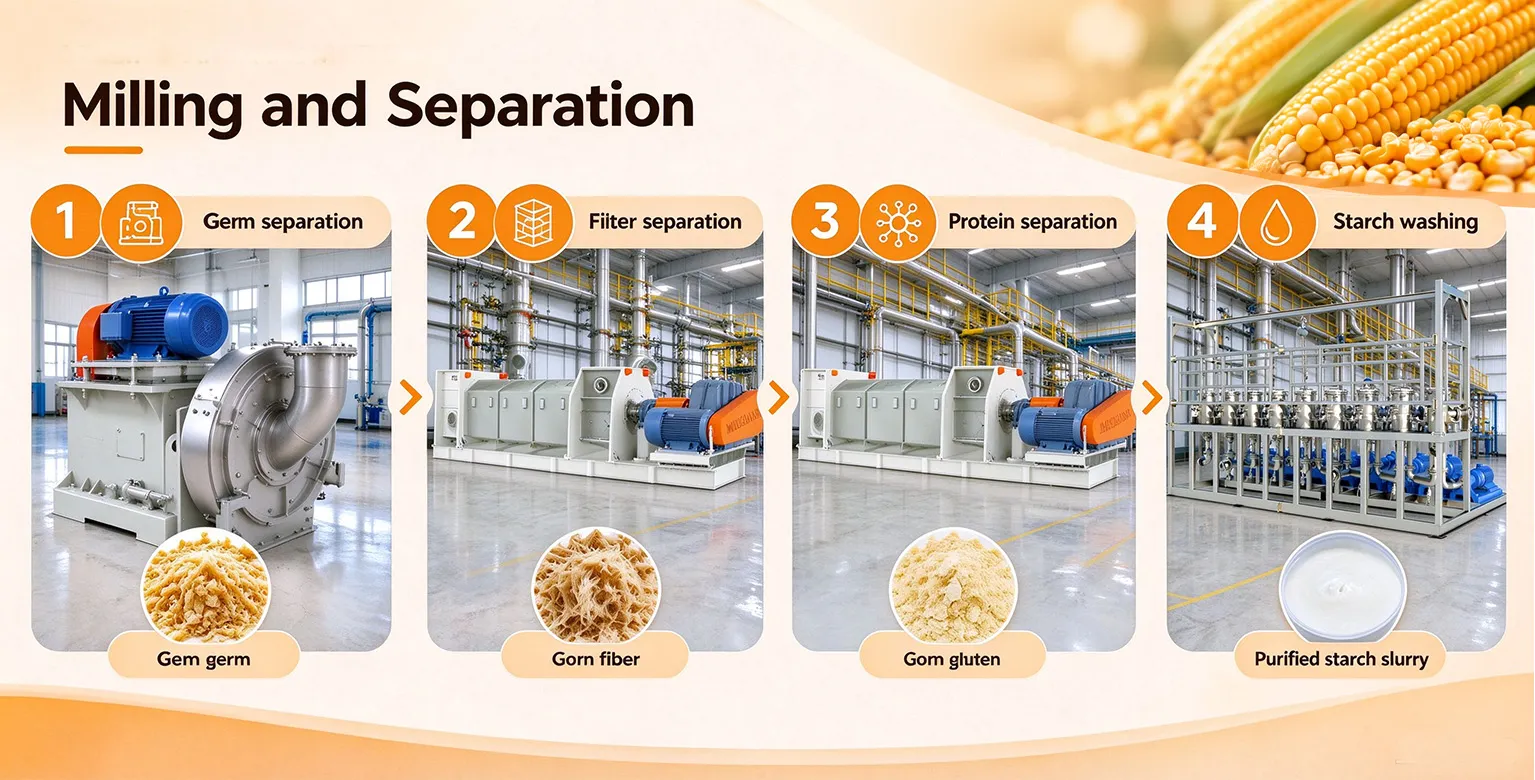
Germ separation
The germ contains oil and other valuable components. After suitable milling, the germ can be separated using differences in density and physical behavior. The plant may then send the germ to oil recovery, feed production, or another approved outlet.
I would evaluate germ separation using more than a single recovery percentage. The assessment should also consider:
🔸Germ purity
🔸Oil content
🔸Starch contamination
🔸Product market requirements
🔸Mechanical damage
🔸Washing and dewatering needs
🔸Integration with an oil extraction route
If the plant sells germ as a feed ingredient, its commercial value may differ from a project that extracts corn oil. Therefore, the downstream plan should be defined before the separation equipment is finalized.
Fiber separation
Fiber removal supports starch purification and can create a feed coproduct. The fiber system may include screening, washing, concentration, and dewatering. Excessive starch loss in the fiber stream can reduce total plant value, while inadequate fiber removal can burden later starch washing.
I would ask the supplier to explain the expected material balance across the fiber system. The buyer should request assumptions rather than accepting an isolated equipment claim. The material balance should identify:
🔸Starch entering the fiber stream
🔸Water added and recycled
🔸Solids concentration
🔸Expected fiber quality
🔸Product losses
🔸Treatment of dilute streams
Protein separation
Protein, often described as gluten in wet-milling discussions, must be separated from starch slurry through controlled density differences and process classification. The separation quality influences starch purity, color, ash, and suitability for food, industrial, or downstream fermentation applications.
The buyer should connect protein separation to the final product specification. A food-grade starch route may require tighter impurity control than an industrial route. A glucose or fermentation project may impose additional requirements on hydrolysis performance and contaminant control.
Starch washing
Starch washing removes soluble materials and remaining protein or fiber. Multistage washing can improve purity, but it can also increase water circulation, pumping demand, and treatment requirements. I would therefore compare washing performance with the complete water balance instead of selecting the highest number of washing stages automatically.
A useful supplier review should include:
| Evaluation area | Buyer question |
| Starch purity | What specification does the route target? |
| Water use | What is fresh water demand and recycle rate? |
| Product loss | Where can starch leave with coproducts or wastewater? |
| Control | How does the system respond to feed variation? |
| Cleaning | How are deposits and contamination managed? |
| Expansion | Can the washing system support future capacity? |
A process route becomes engineering-ready only when these questions connect to equipment sizing, piping, instrumentation, utilities, and operating procedures.
How are dewatering, drying, and coproducts managed in a corn starch production process?
The final product stages determine whether the plant can convert a purified slurry into a stable commercial product. These stages also expose weaknesses in upstream design. If the slurry contains excessive impurities or has inconsistent solids concentration, dewatering and drying may become less efficient or less stable.
The corn starch production process usually includes starch dewatering, drying, cooling, screening, packing, and storage. The plant also needs separate routes for germ, fiber, protein, steepwater, wastewater, and other process streams.
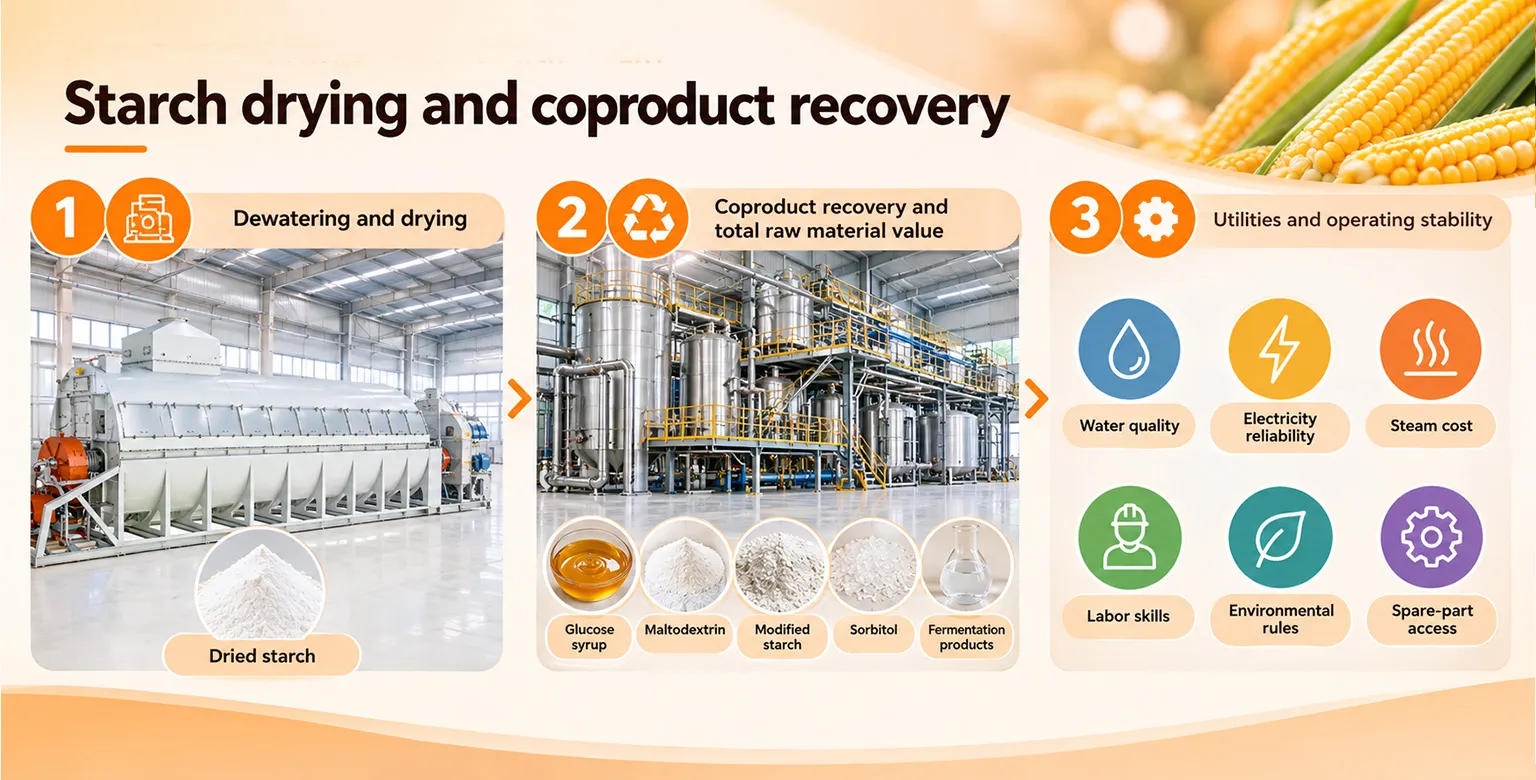
Dewatering and drying
Dewatering removes a significant portion of water before thermal drying. The selected equipment depends on slurry properties, required moisture, capacity, energy conditions, and product handling requirements. Drying then brings the starch to a suitable moisture level for storage and shipment.
I would examine the following points during procurement:
🔸Final moisture specification
🔸Product temperature after drying
🔸Risk of thermal damage
🔸Dust control
🔸Energy source and availability
🔸Heat recovery opportunities
🔸Cleaning and maintenance access
🔸Packaging and warehouse conditions
The final moisture target should not be treated as a universal value. The buyer should confirm it against product standards, customer requirements, storage duration, climate, and packaging format.
Coproduct recovery and total raw material value
A corn plant does not create value only through starch. It also handles germ, fiber, protein, steepwater solids, wastewater, and sometimes oil. I use the phrase “maximum value from every ton of raw material” because the economics depend on the entire material balance.
A commercial evaluation should examine:
🔸Starch recovery and purity
🔸Germ recovery and marketability
🔸Protein concentration and quality
🔸Fiber recovery and feed applications
🔸Water consumption and wastewater load
🔸Electricity and steam consumption
🔸Product losses in dilute streams
🔸Operating hours and maintenance requirements
🔸Potential for future derivatives
For example, an agricultural group may initially plan to sell native starch but later consider glucose syrup, maltodextrin, modified starch, sorbitol, or fermentation products. That possibility can affect building layout, utility capacity, automation architecture, and equipment interfaces today.
Utilities and operating stability
I would never compare two suppliers only by equipment price. I would compare their expected performance under the buyer’s local conditions. Water quality, electricity reliability, steam cost, labor skills, environmental rules, and spare-part access can materially change the preferred process route.
A practical utility review should include:
1. Fresh water demand and recycle strategy
2. Steam demand and condensate recovery
3. Electrical load and backup requirements
4. Cooling water or refrigeration needs
5. Compressed air and instrument air
6. Wastewater quantity and characteristics
7. Dust, odor, and emissions control
8. Automation and data-management requirements
My experience in project discussions is that customers often focus first on installed capacity. Later, they ask whether the plant can maintain stable output during raw material changes or utility interruptions. I believe the second question deserves equal attention because unstable operation can reduce actual annual production even when the nominal capacity appears attractive.
Frequently Asked Questions
1. What are the main steps in the corn starch production process?
The main steps include corn receiving and cleaning, steeping, milling, germ separation, fiber and protein separation, starch washing, dewatering, drying, packing, and coproduct handling. The exact equipment sequence and operating parameters must be adapted to raw material quality, capacity, product specifications, utilities, and local regulations.
2. How long does corn steeping take?
Steeping time depends on corn characteristics, temperature, chemical conditions, equipment design, and the required separation performance. I would not recommend using one universal residence time for every project. The supplier should confirm the design basis through raw material information, laboratory or pilot validation where appropriate, and process engineering calculations.
3. What coproducts can a corn starch plant produce?
A corn wet-milling plant may recover germ, fiber, protein, steepwater-related products, and sometimes corn oil in addition to starch. The commercial value depends on purity, moisture, local feed and oil markets, logistics, and the selected recovery route. Buyers should evaluate coproducts through a complete material balance.
4. What should I request from a corn starch plant supplier?
I would request a process description, preliminary material balance, utility balance, equipment list, layout concept, control philosophy, performance-guarantee basis, implementation schedule, and reference information relevant to the proposed raw material and product route. I would also ask which figures require verification during detailed engineering.
Conclusion
The corn starch production process is an integrated value-recovery system rather than a simple line of machines. I would evaluate raw material preparation, steeping, milling, separation, washing, drying, utilities, coproducts, and future expansion as one connected design. Buyers should compare suppliers through verified technical assumptions, project-specific balances, operating stability, and lifecycle economics. Myande helps agricultural processors assess complete starch and starch-derivative routes around their raw materials, target products, and market goals. Contact Myande to discuss a project-specific process concept and engineering evaluation.

Recent Posts

October 26, 2016
The Most Successful Engineering Contractor




Contact Us
Product Information
Quantity
Unit
Piece
Support order samples, customization, wholesale direct, and complete payment. If the product you look for does not have corresponding customized content, pls fill out the form below to contact us, and we will reply ASAP.