

How to Choose a Bucket Elevator Manufacturer for Grain and Oilseed Processing?
Aug 06, 2026
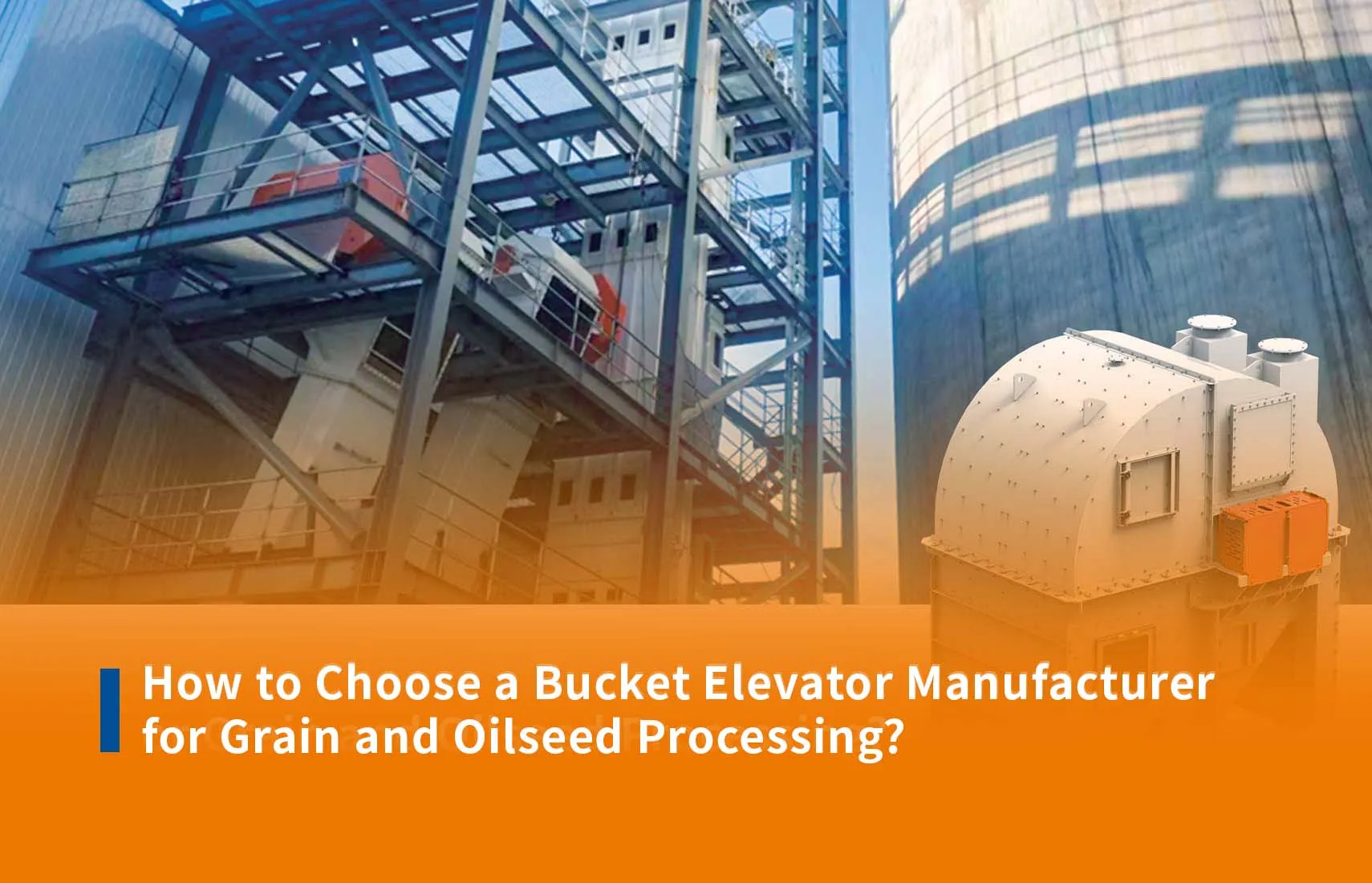
In a modern grain and oilseed processing plant, pretreated materials often need to be lifted vertically to processing or solvent extraction sections located tens of meters above ground level. At this stage, the bucket elevator plays an important role in maintaining continuous material flow and stable plant operation.
Its performance affects more than conveying capacity and energy consumption. For grain, oilseed, and chemical processing facilities, sealing performance, mechanical reliability, and safety are also critical because they can directly influence dust control, working conditions, and overall plant safety.
This is why choosing a bucket elevator manufacturer should involve more than comparing specifications. The manufacturer's engineering experience, equipment design, manufacturing capabilities, safety features, and project track record all need to be considered.
What Should You Look for in a Bucket Elevator Manufacturer?
The first consideration is the manufacturer's technical capability and experience in designing equipment for demanding industrial applications.
A mature bucket elevator design should be able to operate reliably under continuous, high-load conditions while addressing common challenges such as dust leakage, material return, energy consumption, and safety risks.
Myande's TDTG series bucket elevator uses a modular structure consisting of four main sections: the boot, casing, head, and drive system. The modular design simplifies transportation and installation while allowing the elevator to be configured according to the required lifting height, with lifting heights of up to 60 meters.
The equipment can also be adapted to different plant layouts and operating conditions, making it suitable for large-scale grain, oilseed, and chemical processing applications.

How Does a Bucket Elevator Control Dust and Improve Safety?
Dust control is an important consideration in grain and oilseed processing plants. Poor sealing can allow dust to escape into the surrounding work area, affecting housekeeping, working conditions, and plant safety.
The TDTG series incorporates optimized sealing and airflow designs to help reduce dust leakage during operation.
For applications with higher safety requirements, an optional explosion-venting casing can be installed to provide an additional safety measure for potentially hazardous operating environments.
The drive system can also be equipped with an explosion-proof motor and optional sensors for belt misalignment, temperature, and belt speed or elevator operation status. These signals can be connected to a remote monitoring system, providing operators with additional data for equipment condition monitoring and maintenance planning.
How Can Bucket Elevator Design Improve Conveying Efficiency?
The design of the bucket and feeding system has a direct influence on conveying performance.
The TDTG series uses high-strength CC-type deep buckets together with a multi-layer rubber belt designed for demanding operating conditions. The dense bucket arrangement and optimized bucket geometry help increase conveying efficiency.
An adjustable tongue-board feeding system guides material into the buckets through an induced feeding process. This helps reduce material return and unnecessary digging, improving material handling efficiency.
According to Myande's stated performance data, the system can increase throughput by at least 15% while reducing energy consumption by more than 20% compared with comparable equipment.
These improvements are particularly relevant for high-capacity processing plants, where even relatively small differences in conveying efficiency can accumulate into significant differences in operating costs over time.

Why Does Manufacturing Quality Matter for Bucket Elevators?
Good equipment design needs to be supported by consistent manufacturing quality.
Bucket elevators operate continuously and often handle large quantities of material. Structural accuracy, connection quality, surface treatment, and component consistency can therefore affect long-term reliability.
Myande manufactures its equipment at an integrated manufacturing base where key processes, from material preparation and forming to connection, surface treatment, and assembly, are subject to structured quality control.
For the TDTG series, bolted connections are used in the equipment structure instead of relying entirely on conventional welding. This helps reduce the risk of structural deformation associated with welding and supports dimensional accuracy during assembly.
The casing can also receive paint-based surface treatment to improve corrosion resistance, allowing the equipment to operate in challenging environments such as coastal areas and regions with high temperature and humidity.
How Does Global Project Experience Improve Equipment Reliability?
Equipment performance needs to be validated under real operating conditions.
Grain and oilseed processing facilities can vary significantly in terms of raw materials, production capacity, climate, plant configuration, and operating requirements. Experience across different projects gives a manufacturer practical insight into how equipment needs to be adapted to these conditions.
Myande has supplied equipment and engineering solutions for projects in more than 80 countries and regions, covering industries such as:
🔸Oils and fats
🔸Starch processing
🔸Fermentation
🔸Brewing and food processing
🔸Material storage and handling
🔸Evaporation and energy-saving systems
Its international project experience includes applications across Southeast Asia, South America, the Middle East, and Africa.
For a bucket elevator manufacturer, this type of project experience is valuable because the equipment is rarely used as an isolated machine. It needs to integrate with upstream conveying systems, processing equipment, automation systems, and the overall plant layout.
What Services Should a Bucket Elevator Manufacturer Provide?
For large industrial projects, equipment supply is only one part of the overall process.
A capable manufacturer should be able to support customers through multiple stages of a project, including:
1. Technical consultation and planning: Understanding material characteristics, conveying capacity, lifting height, and operating conditions.
2. Process and equipment design: Selecting and configuring the bucket elevator according to the overall production line.
3. Equipment manufacturing: Producing the elevator and key components under controlled manufacturing conditions.
4. Installation and commissioning: Ensuring the equipment is correctly integrated into the production system.
5. Automation and monitoring: Connecting sensors and operating data with the plant's control and monitoring system.
6. After-sales support: Providing technical assistance throughout the equipment's operating life.
This approach can reduce the risks associated with coordinating multiple equipment suppliers and help ensure that the conveying system works effectively as part of the complete production line.
How Should You Choose a Bucket Elevator Manufacturer?
When selecting a bucket elevator manufacturer, price and nominal capacity should not be the only criteria.
A more complete evaluation should consider:
🔸Lifting capacity and height: Can the equipment meet the required throughput and vertical conveying distance?
🔸Material compatibility: Is the design suitable for the raw material and its physical characteristics?
🔸Dust control: Does the equipment provide effective sealing and dust containment?
🔸Energy efficiency: How does its power consumption compare with alternative designs?
🔸Safety: Are explosion protection and condition-monitoring options available where required?
🔸Manufacturing quality: Does the manufacturer have reliable fabrication and quality-control capabilities?
🔸Automation: Can operating data be integrated with the plant's control system?
🔸Project experience: Has the manufacturer supplied similar equipment for large-scale industrial plants?
🔸Engineering support: Can the supplier provide design, installation, commissioning, and technical support?
These factors provide a more practical basis for comparing manufacturers than equipment specifications alone.
From Bucket Elevator Equipment to Integrated Material Handling Solutions
A bucket elevator is a relatively compact piece of equipment, but its role within a processing plant is much larger. Reliable vertical conveying helps maintain material flow between processing stages, while effective sealing, safety systems, and condition monitoring contribute to stable plant operation.
Myande's TDTG series bucket elevator combines modular equipment design, dust-control measures, safety options, energy-efficient conveying, and integration with automated plant systems. Its application across international grain, oilseed, starch, fermentation, and material handling projects provides practical experience for different operating environments.
For companies evaluating bucket elevator manufacturers, the key question is therefore not simply which machine has the highest capacity or lowest purchase price. It is whether the manufacturer can combine equipment design, manufacturing quality, safety, energy efficiency, automation, and project engineering into a reliable solution for the complete production system.


Recent Posts

October 26, 2016
The Most Successful Engineering Contractor



Contact Us
Product Information
Quantity
Unit
Piece
Support order samples, customization, wholesale direct, and complete payment. If the product you look for does not have corresponding customized content, pls fill out the form below to contact us, and we will reply ASAP.